
How marketing teams structure in 2025
Generalist vs specialist and the signals in between

You’re reading ‘Inside Product-led Content’ — weekly-ish, 2-min reads on building a LLM-optimized product-led content library by me, Masooma 🤓
If a colleague or peer forwarded this email to you and you wanna keep in touch, subscribe here for free.
Paprika-dusted hummus and cucumber.
Yep, that’s the snack powering today’s newsletter. That, plus a bunch of observations I’ve been making on how marketing teams are operating this year, career laddering, and scaling.
Thing is, left and right, you’ll find loaded takes on social:
→ Founders building in public
→ Marketing leads sharing their first 90 days
But the messy middle? The part where you’re trying to sustain growth without bloating headcount. That messy middle is quiet. And it’s the space I’ve been paying attention to.
Because it’s where most of us actually live.
All credit to a mishmash of AI hype, layoffs, and tighter budgets — leaving leaders asking:
How do we keep pipeline moving without stretching our teams thin?
I’ve often asked myself a similar version of this question as a consultancy owner of 9 years:
How do I keep momentum without scaling into bloat? How do I meet marketing teams where they need it most — right here in the messy middle?
Luckily, when you look, there are always signals blinking at you — scattered at first, like needles in a haystack, but forming a pattern over time.
And as we head into Q4, I’m sharing the ones that have shaped both my growth this year and the way marketing teams are now structuring theirs.
How marketing teams are being re-architected
8 weeks into her new role as Head of Marketing at Aligned, Ashley Lewin had already spoken with 15+ vendors, hired five, and let a few go.
Her takeaway? Marketing teams today aren’t built like they used to be.
If you’re a director trying to grow without headcount bloat, her approach will feel familiar.
The shift’s now from in-house teams handling everything — with contractors as order-taking task-doers — to lean cores supported by specialist partners who co-own strategy and execution.
Ashley shared she built her team around this change:
“I act as the internal architect. They [contractors] plug in as specialized partners. And honestly? I think this is where more marketing teams are headed.”
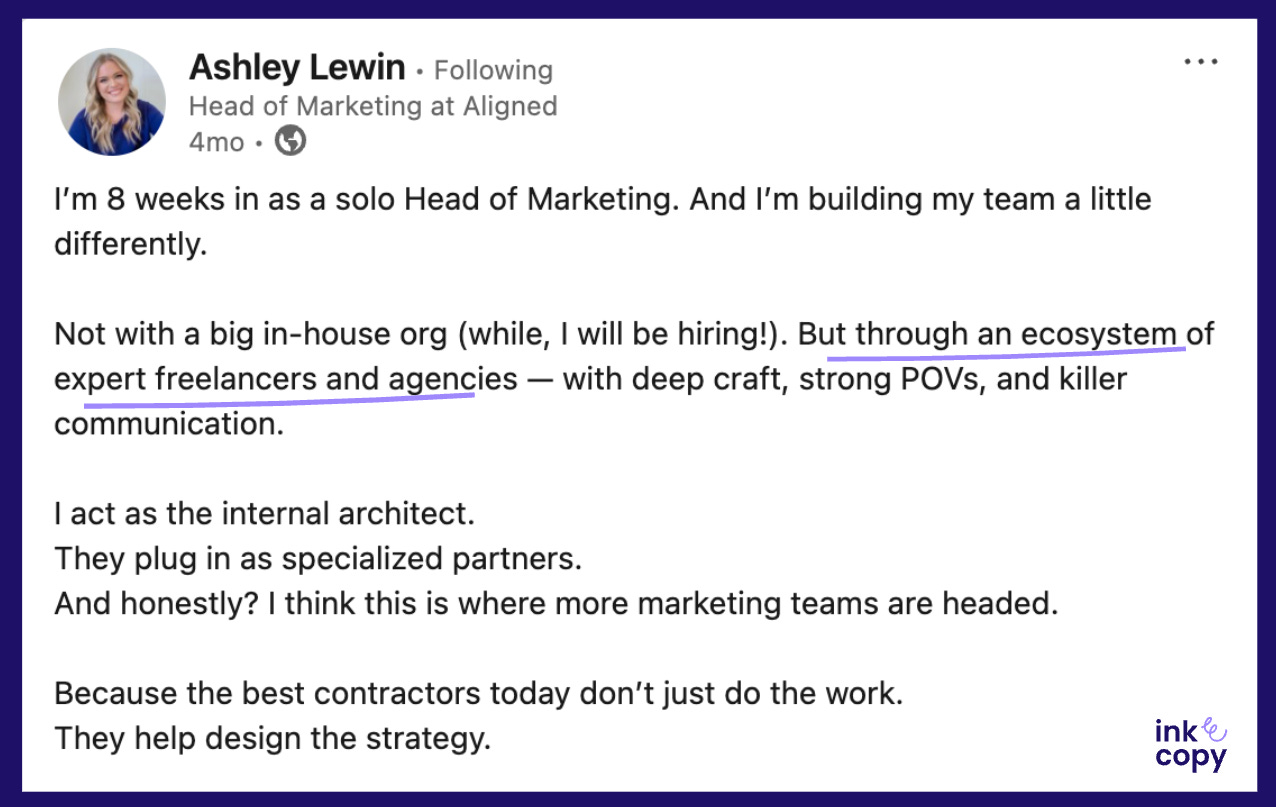
When I read Ashley’s post, I was walking out of the thick of launching my product-led content library offer.
So her post felt like she put a spotlight on the principles I’ve always logged mentally for running InkandCopy: a small, focused, end-to-end partner with a strong POV.
Most of all, her post did one thing really well:
It validated the direction I’ve been taking — proof that the shift wasn’t something only I’d been quietly noticing, but a path worth doubling down on.
For context: the most obvious career trajectory for a contractor doing well is to scale into an agency. Nothing wrong with that. It’s just never been the direction I wanted to take.
Why strategy without execution falls flat
Christina Le doesn’t know it yet, but she gave words to my business philosophy:
“No one is above doing the work, and this market moves way too fast for you to just be a strategist.”
Another nod in the direction Ashley pointed:
You’ll see the real advantage comes from strategic partners who own their area end-to-end.
But here’s the nuance, it’s easy to mistake a “strategic partner” for an “outsourced vendor.”
The real value, however, comes from a done-with-you setup — where the contractor carries the weight of the work and you keep the goals visible through proactive communication:
Onboard them as if you were bringing on a new FT hire.
Flag updates early instead of expecting them to read between the lines.
Give context-rich feedback so they can align more closely with your goals.
You’re reading ‘Inside Product-led Content’ — weekly-ish, 2-min reads on building an LLM-optimized product-led content library by me, Masooma 🤓
If a colleague or peer forwarded this email to you (and, well, you liked it):
As for me, this was another stamp of approval — a marker that the signals weren’t just mine, but market-wide.
Because when they say, “build what you believe in,” it sounds romantic.
But without signals like these, it’s just wishful thinking.
Not to mention, staying close to the craft matters.
It means my frameworks are stress-tested in execution, not sketched in theory.
That’s why the product-led content libraries I build for SaaS teams sit on strategy and execution — one without the other collapses. And notably, it’s the same mix these market signals keep pointing to.
Why generalist marketers will thrive
Like Ashley, Emily Kramer of MKT1 sees in-house marketing leads as the glue that holds the system together.
She calls them Gen Marketer:
“[Leaders who can] flex across functions, stitch together AI and human work, and orchestrate end-to-end campaigns are the ones who will thrive.”
So the real unlock for in-house leads?
Building your muscle as part campaign manager, part product marketer, part AI expert. Someone who can:
Connect product, distribution, and audience insights.
Expand their toolkit with AI workflows and agents.
Run end-to-end campaigns while managing external specialists.
For me, Emily’s observation comes at the tail end of the year — long after I launched my PLC library offer.
So it worked less as a market signal, and more as a ‘whoo-hoo: I’ve pulled the right lever’ reminder.
Because those early divided feelings — almost holding my breath when deciding to go deep instead of broad with InkandCopy — were scary.
The fear was real: Will this work or will it leave me staring at a shrinking pipeline?
Turns out, the bet paid off. *Phew*
But the broader lesson here goes beyond my story:
The messy middle is less about more hands and more about the right mix of brains — sharper generalists inside, stronger partners outside. Because pipeline doesn’t need more hands, it needs the right brains.
======
Curious: For the current market, what’s the one skill you’re sharpening most?
Not to be sappy, but this newsletter would still be a half-finished draft if not for you reading it. So thank you for being here 🙏
I’d say I’d give you my iced Spanish latte… but let’s not get carried away!
Oh and you’re in good company, habibi — marketers from some of the best brands are reading this right alongside you:

We are in an interesting time, aren't we? A lot of my former colleagues have decided to go the fractional route and hone in on their very unique and specific skillsets. They join companies for a period to help develop the foundation and then once the project is over, they move on and do it again somewhere else. I think it's particularly interesting w/ how we're envisioning marketing teams in the future. I think we'll have a lot more Ashley's who stands as the internal person and then have folks join on fractionally, especially when it's in the experiment phase.
Thanks for including me in this piece!