
What’s inside a PLC library
An insider look at how buyers buy today and the content they actually need.

Thought I’d design a grand visual to show you what a product-led content (PLC) library looks like.
But the more I plan plough through the layout, the more detailed it gets. And the more detailed it gets, the more I worry it gets confusing.
It’s like watching a Venn diagram turn into a hypnotic swirl 😱
So perhaps it’s time to do detailed explainers with a handful of diagrams? Or a separate pop-up email series? Or wait, maybe a video masterclass?
(Hit reply and tell me please!)
Anyway, in the spirit of taking you behind the scenes, I did manage to put something together.
But before I share it, we need to pause here for a bit of a reality check:
All this content that makes up a PLC library sits on a foundation of thorough target buyer, product, and market understanding.
And not just understanding but proper documentation that you can’t leave out since you’ll need it to:
Nail consistent product positioning
Scale content production
Train your writers and/or AI workflows
In fact, my clients and I spend at least a good 15 days on setting this foundation.
If you’ve already done some of the groundwork, we work on expanding and refining it, so your product-led content does, in fact, drive conversions down the line.
Now for:
The heart of it all: A strategy based on today’s buyer journey
Traditional content strategies plan content out for funnel stages. But the funnel is rigid and doesn’t reflect how buyers buy today:
→ 89% of buyers use AI to find SaaS solutions and evaluate them.
→ Buyers are self-serve. They study what your product can do before they ever reach out or take that free trial (69% of buying journey is complete before the buyer ever reaches out).
→ Buying committees are growing (27% of buyers have more c-suite decision-makers involved).
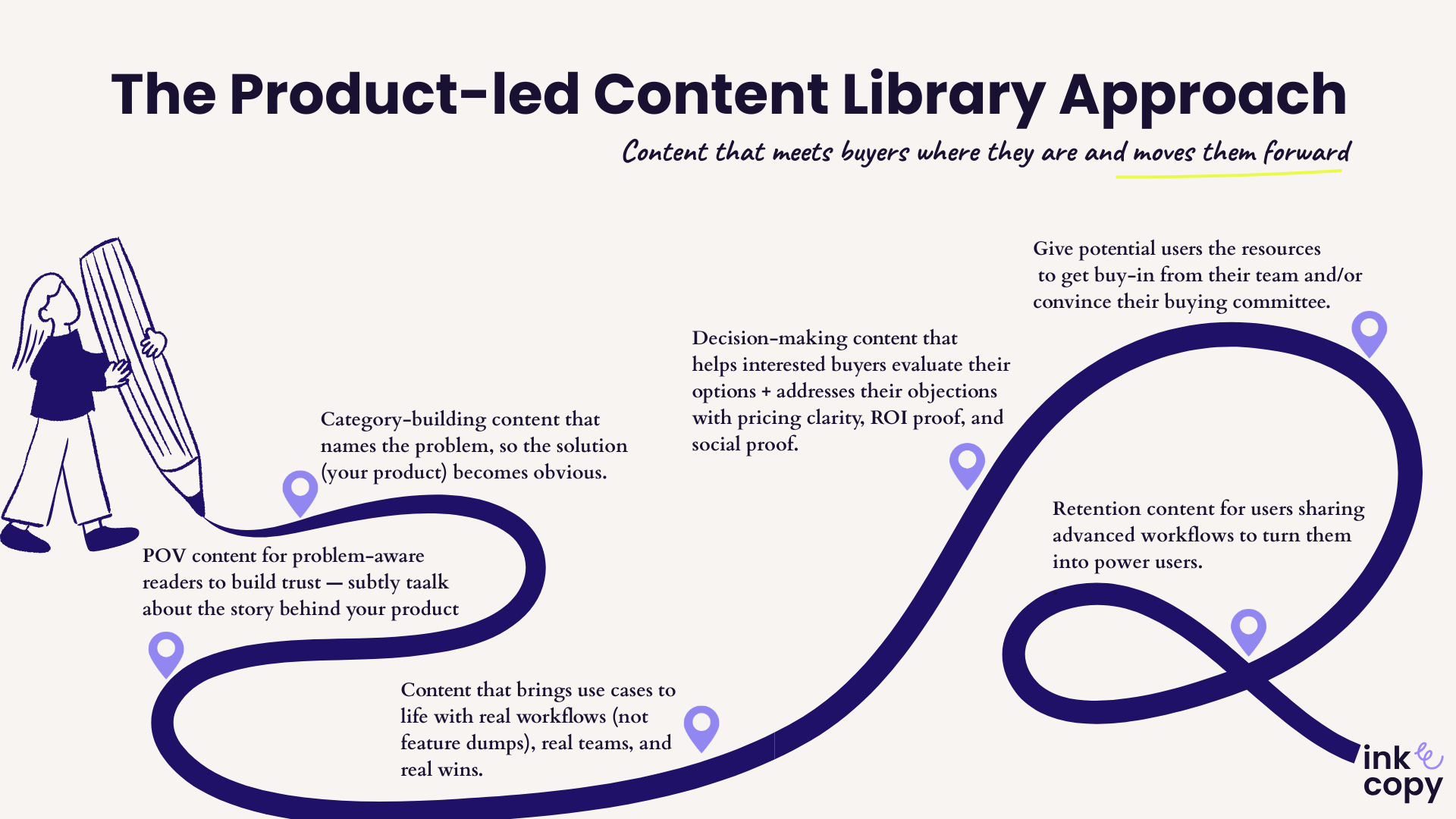
So you need content to meet this behavior — to create resources that make your product discoverable, explain how it works, and also help your target buyer make their buying decision.
In practice, a content roadmap that aligns with the modern buying journey roughly looks like this:
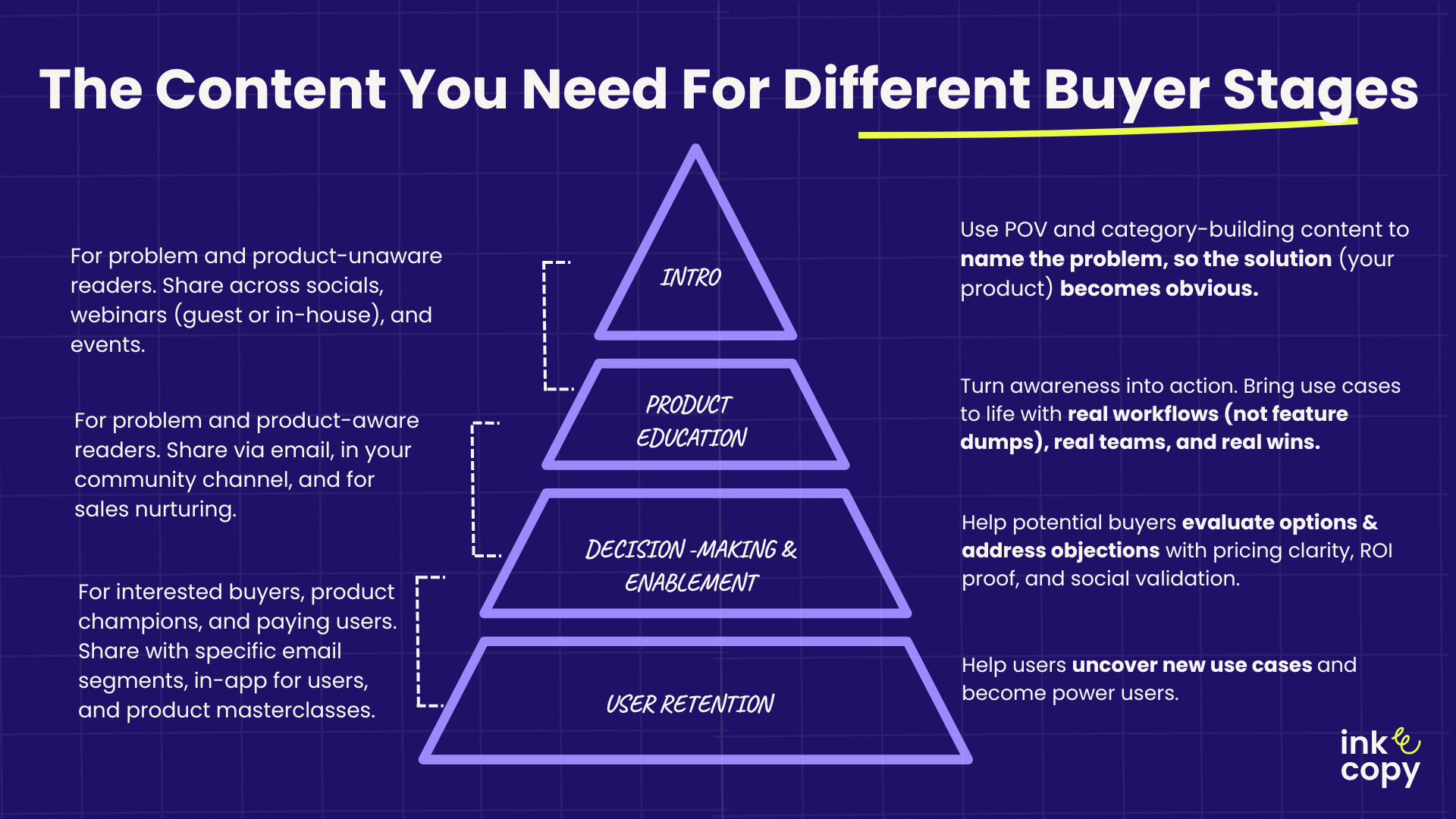
The pillars: Content for different stages of the buyer’s journey
So if planning content by funnel stages doesn’t cut it anymore, what does?
Planning for each stage of the buying journey above.
In the early stage, you’d have problem- and product-unaware readers
A little further, you’d have problem-aware but product-unaware readers
Next, you’d have product-aware readers, but ones who aren’t ready to buy yet
And then, interested buyers — people who are evaluating their options
For each stage, I jot down the questions these people are asking. Then, using these questions, I settle on the content topics and angles to answer them.
For my clients who already have writers on board and work with me on the strategy and planning (not including execution), I also make sure each set of monthly content briefs has a point of view (POV) to cover.
Without POV, product-led content turns out dry, boring, and pretty salesy.
So you need to be sharing your POV to maintain the trust you’ve built with the buyer.
The bow tie: Optimize content for Google and AI search
Last stop, this is where I map content against the keywords you want to target and the prompts you want to show up for in LLMs like ChatGPT.

From here on, you’d be in tip top condition to start creating content that ideally supplements your brand building campaigns — I’ll tell you more about when you can benefit from a PLC library the most tomorrow.
For now, a question for you: