
How Superhuman does product-led content
A bit of a teardown of 3 of their blog posts.

Yesterday, I took you through how to plan product-led content (PLC) for different stages of the buyer’s journey. And last week, we looked at the 3Rs of nailing PLC:
→ Relevance: Does your content meet buyers where they are?
→ Resonance: Does your content win your buyer’s trust?
→ Resourcefulness: Is your content contextually useful to your buyer?
Today, let me take you through how the email productivity app, Superhuman, does product-led content.
Since I can’t break down their entire strategy in one short email, let’s see how 3 of their blog posts nail the 3Rs of product-led content.
Quick heads-up before we begin, you’ll leave with a better understanding of how PLC works if you’ve read both yesterday’s email and the 3Rs piece.
1. Content under review:
✨ Why Funnel Efficiency is the New Key to Revenue Growth
How it follows the 3Rs of product-led content:
✅ Relevance
Meets the target audience in their pre-buyer journey, doing the sophisticated job of naming the problem the target buyer is already struggling with to make the solution obvious.
Target readers:
Problem aware but product unaware
Content’s goal:
Grow problem awareness
Earn/strengthen trust
✅ Resonance
There’s a strong angle/point of view (POV) this piece makes: it goes against conventional advice of changing entire processes — making points in favor of consistent iterating to solve the revenue problem.
The following lines in the intro do this:
“Every sales leader knows the feeling: your pipeline numbers look healthy, leads are flowing in, but deals get stuck in the middle.
Conventional wisdom often boils down to "more pipeline" or "better leads" — but top-performing revenue teams know that significant, sustainable growth can come from optimizing what happens after folks enter the pipeline.”
The content backs its POV with insights from teams who have struggled with the same but came out strong.
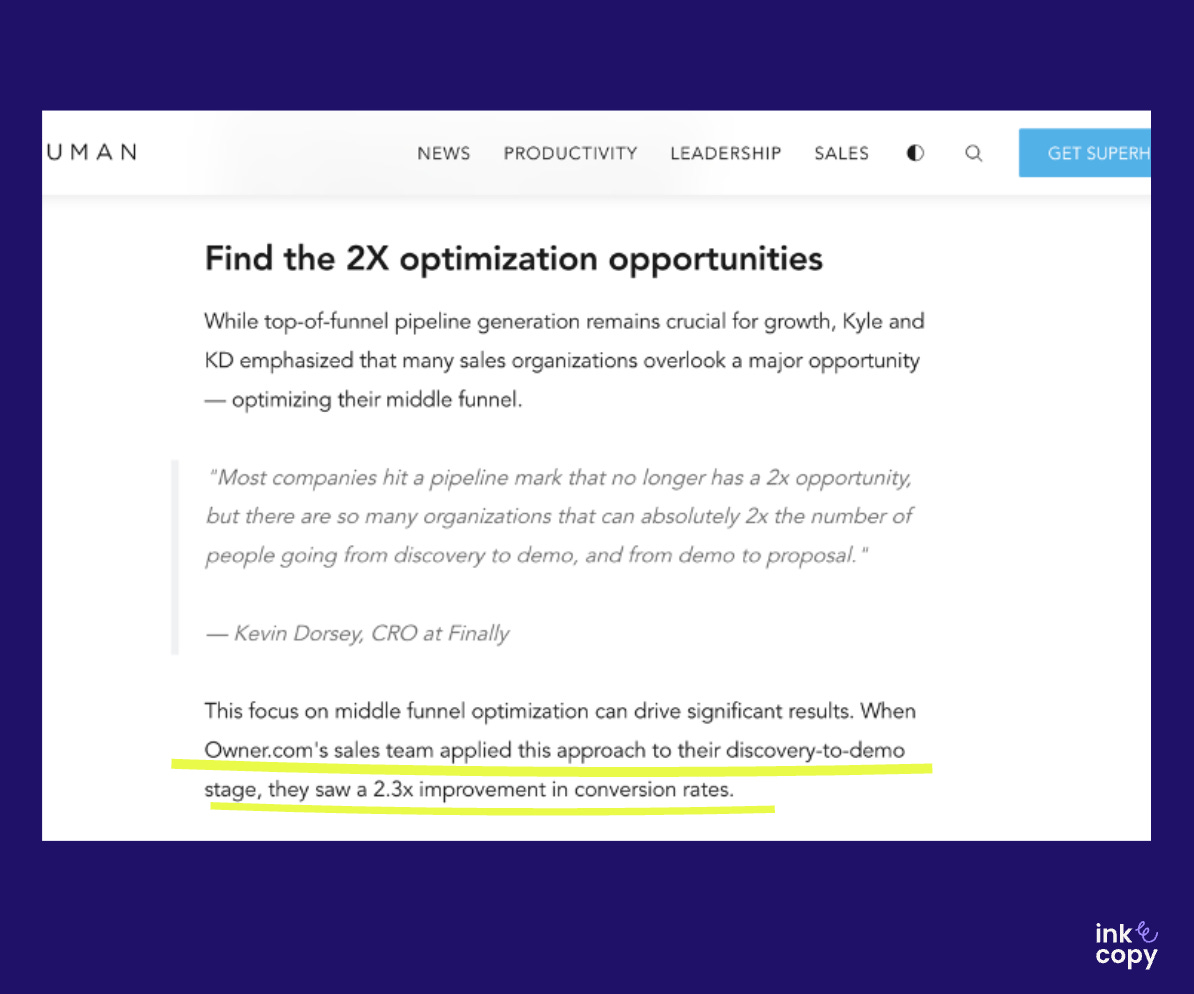
Throughout, it continues touching on the common challenges the featured experts faced, which amplifies relevance because it makes buyers feel seen.
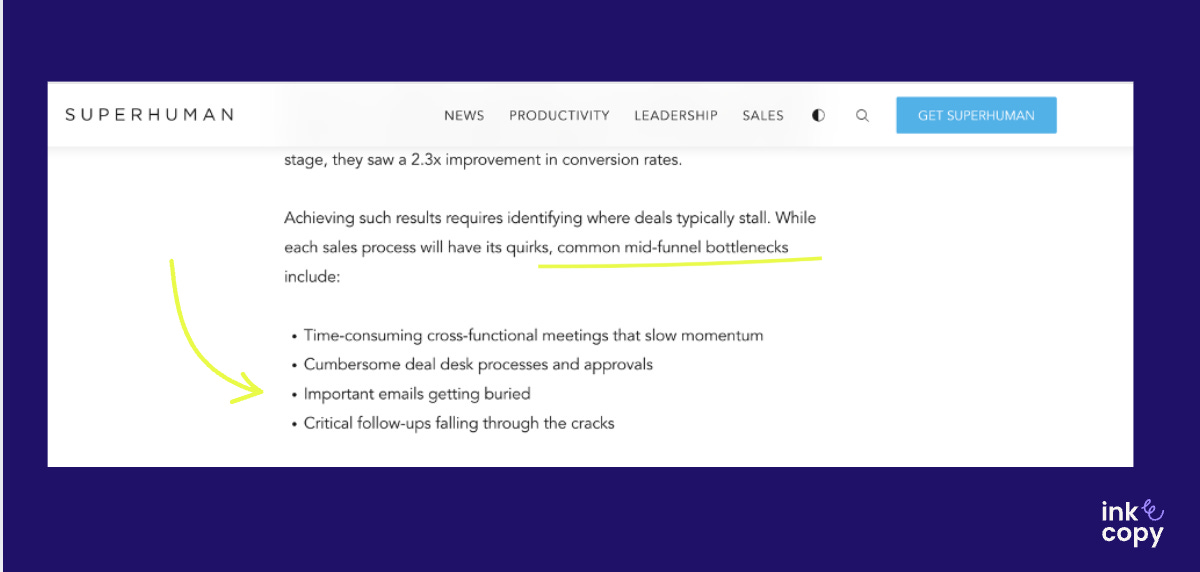
✅ Resourcefulness
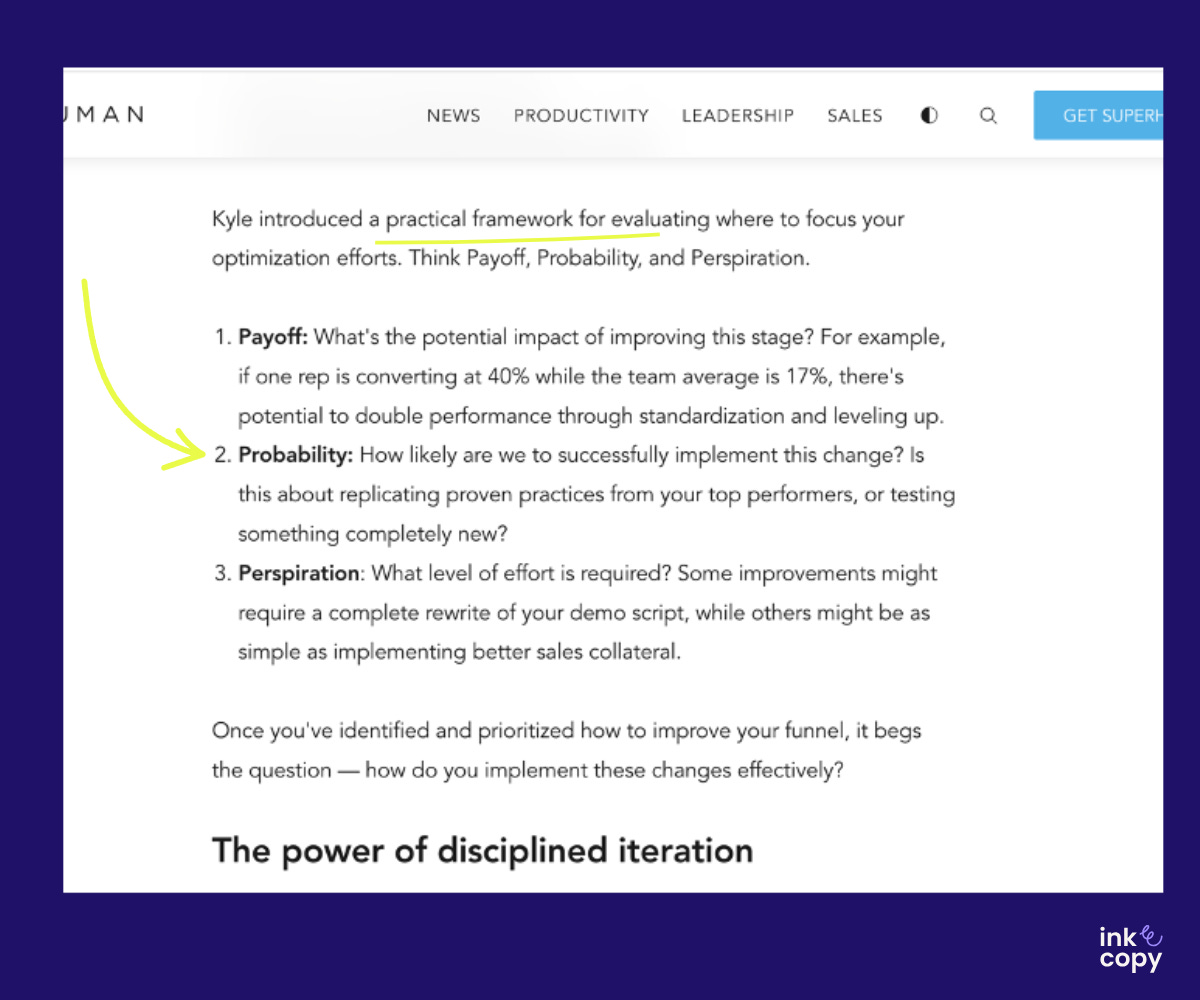
Content packs in tactics and frameworks their target readers can reference.
Here’s one, for example:
The piece also links to the webinar featuring the full conversation with the featured experts – great way to pull readers into their content library and making the content further useful for them.
There’s another internal link to a very relevant webinar in a blue call-out box in the piece. Another solid move to get readers deeper into their content library.
Bonus: What I’d have done differently
This piece closes with a product sign-up CTA which makes no sense here — esp. since they don’t even talk about Superhuman in this piece.
It’s just not the natural next step the reader would want to take here. I’d have linked to another relevant resource here.

2. Content under review:
✨ How to use Team Comments to reimagine email collaboration
How it follows the 3Rs of product-led content:
✅ Relevance
Meets the reader where they are at in their journey, doing a very specific job of educating on how and in what ways the Team Comments feature can help them.
Target readers:
Problem- and product-aware readers
Superhuman users
Content’s goal:
Feature education
Improve user retention
✅ Resonance
Opens with a relevant struggle that teams often find themselves in — effectively setting the stage for using the Team Comments feature.
Then, the piece talks about the feature by framing the benefits for the user/reader, making it buyer-first content.
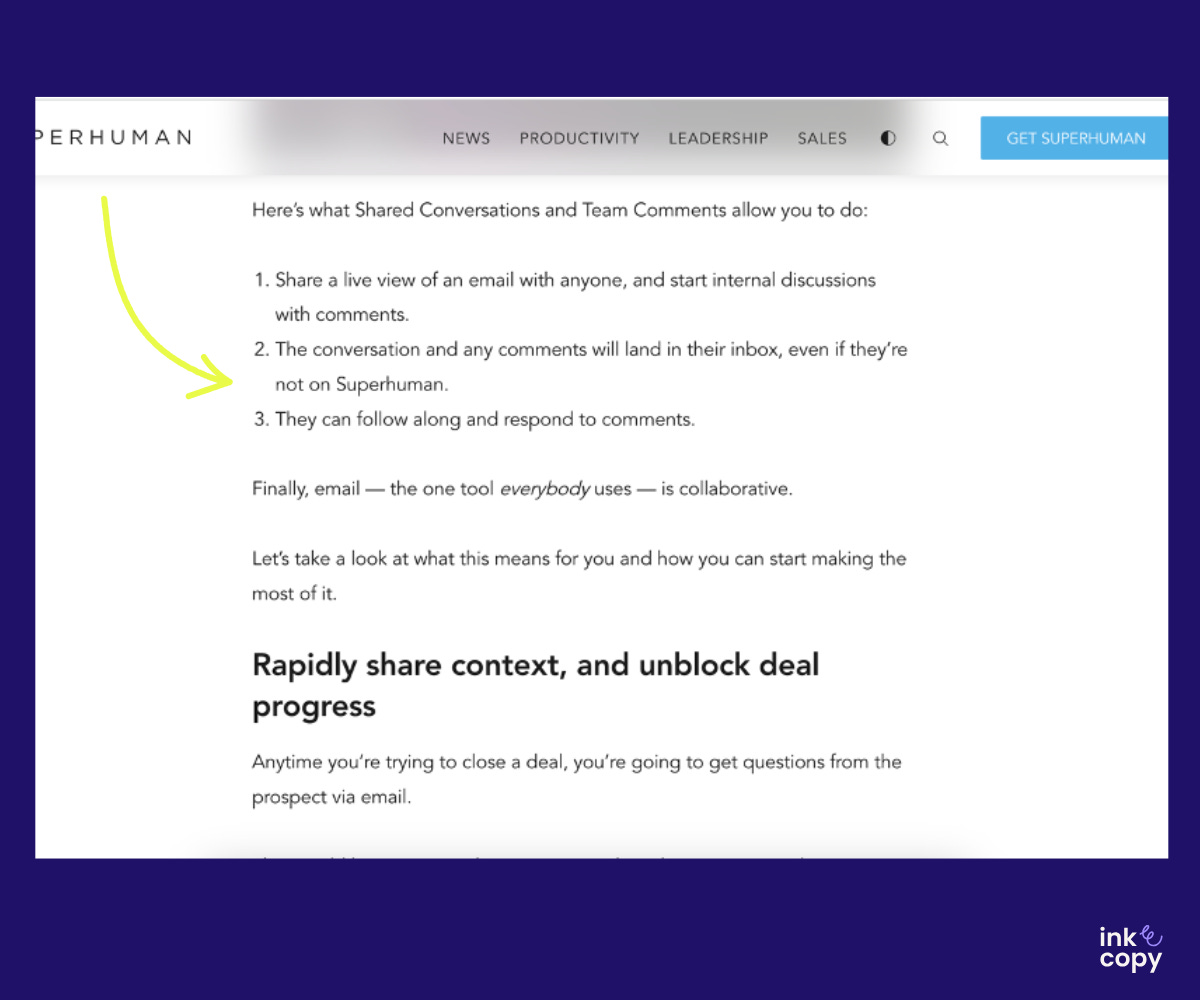
✅ Resourcefulness
Outlines steps to use the tool in a call-out blue box, which makes it easy for users to return to them,
Covers both the ‘how’ to use the feature and explains the ‘ways’ to use it. Here’s just one look at it:
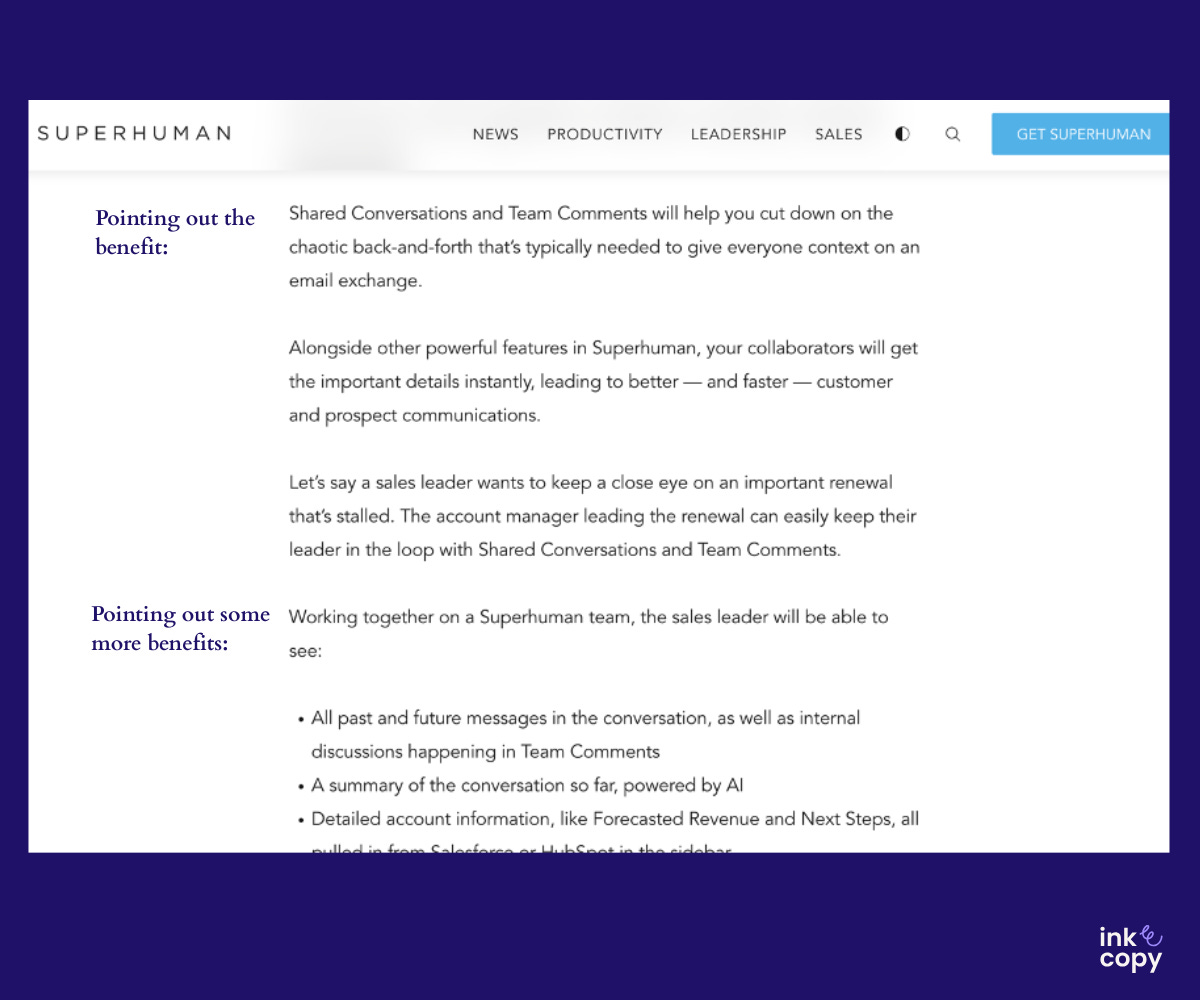
They also share how the feature works for both Superhuman users and non-users, complete with a GIF 👏
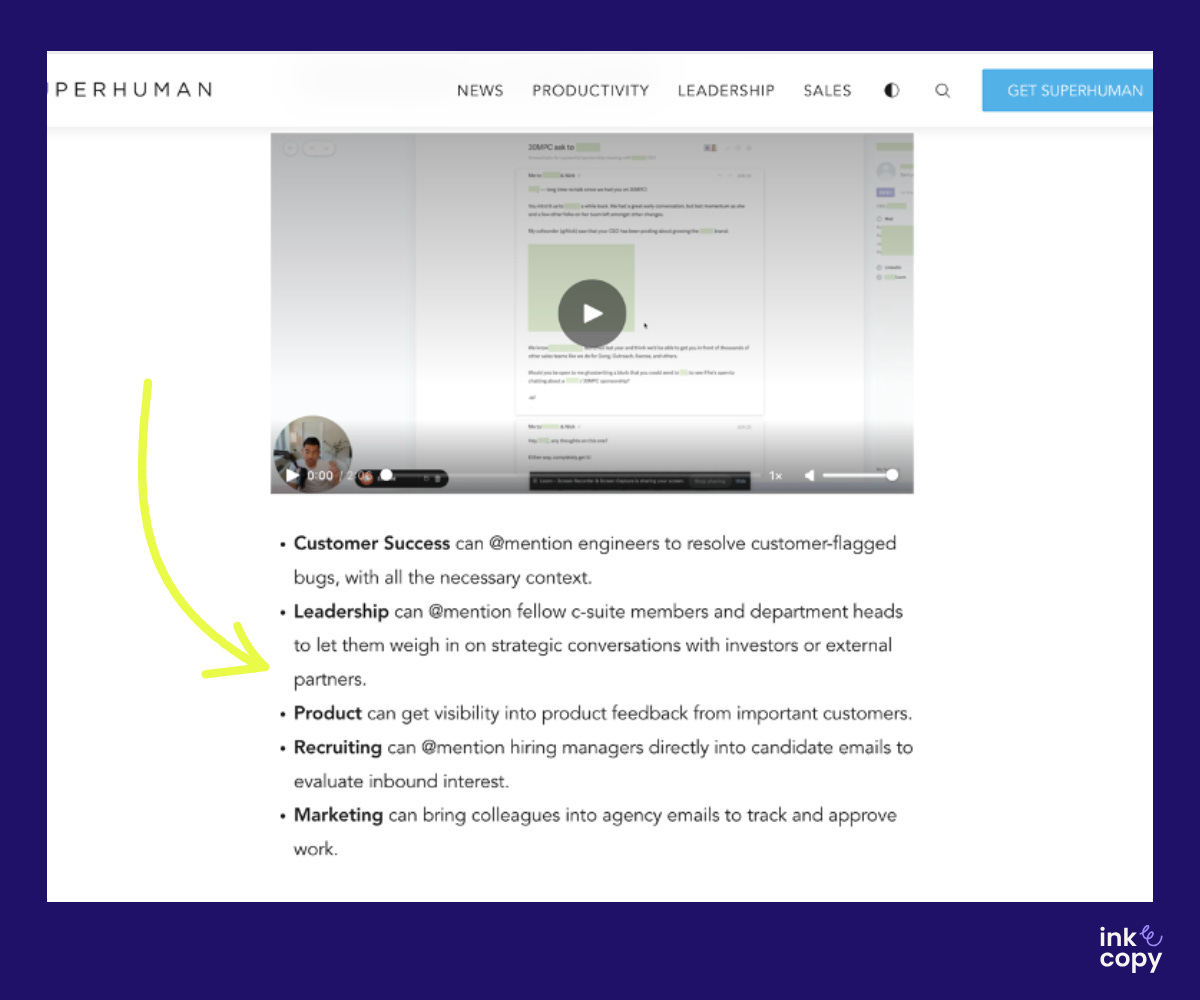
In a section on “How different departments can use Shared Conversations and Team Comments,” they also explain how different users from the same company account can make the most of the feature.
This is a great way to get users to use more of the app (which improves their customer lifetime value).
3. Content under review:
✨ How to boost sales rep productivity with HubSpot & Superhuman
How it follows the 3Rs of product-led content:
✅ Relevance
Understanding how a potential tool a buyer is considering integrates with the rest of their tech stack is a leading question prospects ask.
This piece addresses that question — making it a hyper-relevant piece in Superhuman’s product-led content strategy.
Target readers:
Product-aware readers
Superhuman users
Content’s job:
Workflow education
User retention
✅ Resonance
The content captures relatable pain, backing it with research to get readers’ attention.
The opening line feeds on the struggle itself:
“Often the biggest improvement to a sales team's tech stack is a better integration, not a new tool.”
The reader goes, ‘ah, yess! I can’t do another tool – thank you for your honesty.’
Also, 10/10 for this line:
“The cornerstones of the sales stack are email and a CRM, and the bar for an integration should be much higher than ‘doesn't break.’”
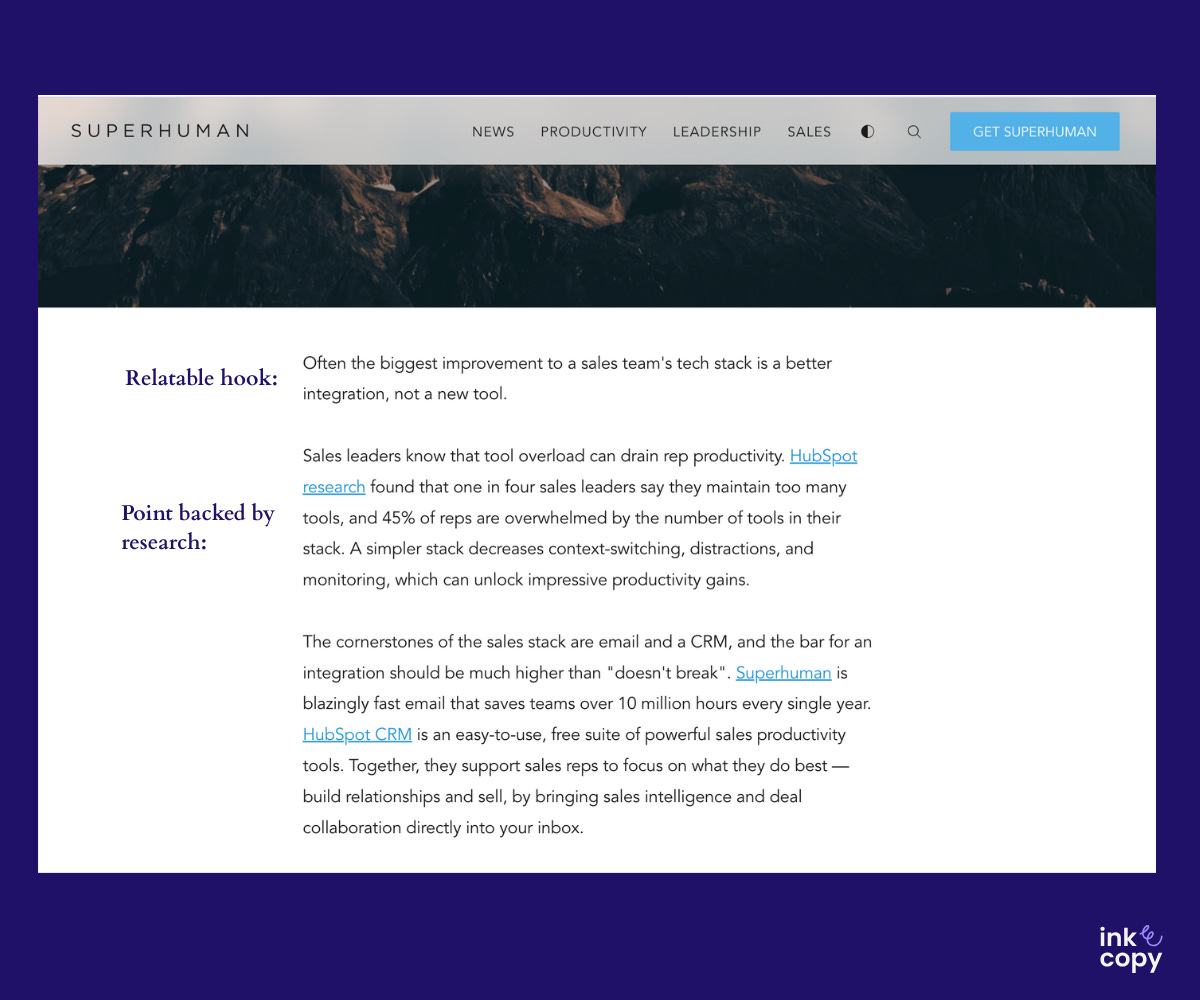
As with their other content, Superhuman takes a benefits-first approach here as well.
Here, for instance, they explain a benefit (“lets reps focus on the deal data that matters most”) while tackling an objection (“without ever breaking their inbox workflow”) a reader has in their mind:
“The customizable view lets reps focus on the deal data that matters most, without ever breaking their inbox workflow.”
Then it does a brilliant job of backing the benefit with proof using a quote from a Superhuman user who sends 50 emails per day:
“Superhuman sidebar saves me 3-4 minutes on every email”
Any reader would do the math here: if each email saves 3-4 minutes, how many would 50 emails save me?
Yess, that’s right, it’s 150-200 minutes! 2.5 to 3.3 hours. Huge! And good stuff to sell Superhuman to an interested buyer.
✅ Resourcefulness
The piece does a full product workflow breakdown — how the integration works with steps explained in a call-out box.
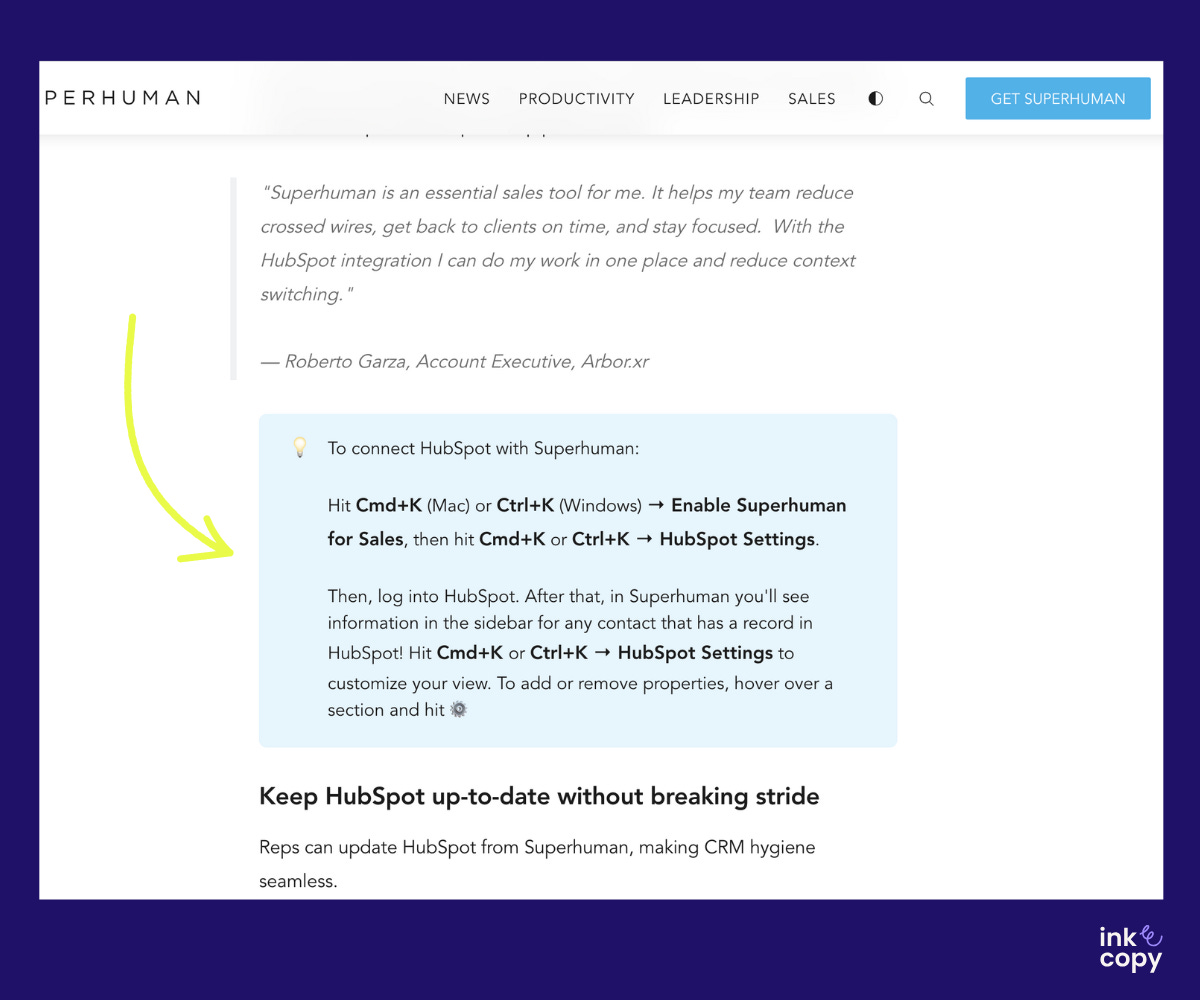
Not only does this call-out box make it easy for users or new buyers to return to the step, it also makes it easy for LLMs to pull out the information when a user searches for the same info there.
Bonus: What this piece does brilliantly
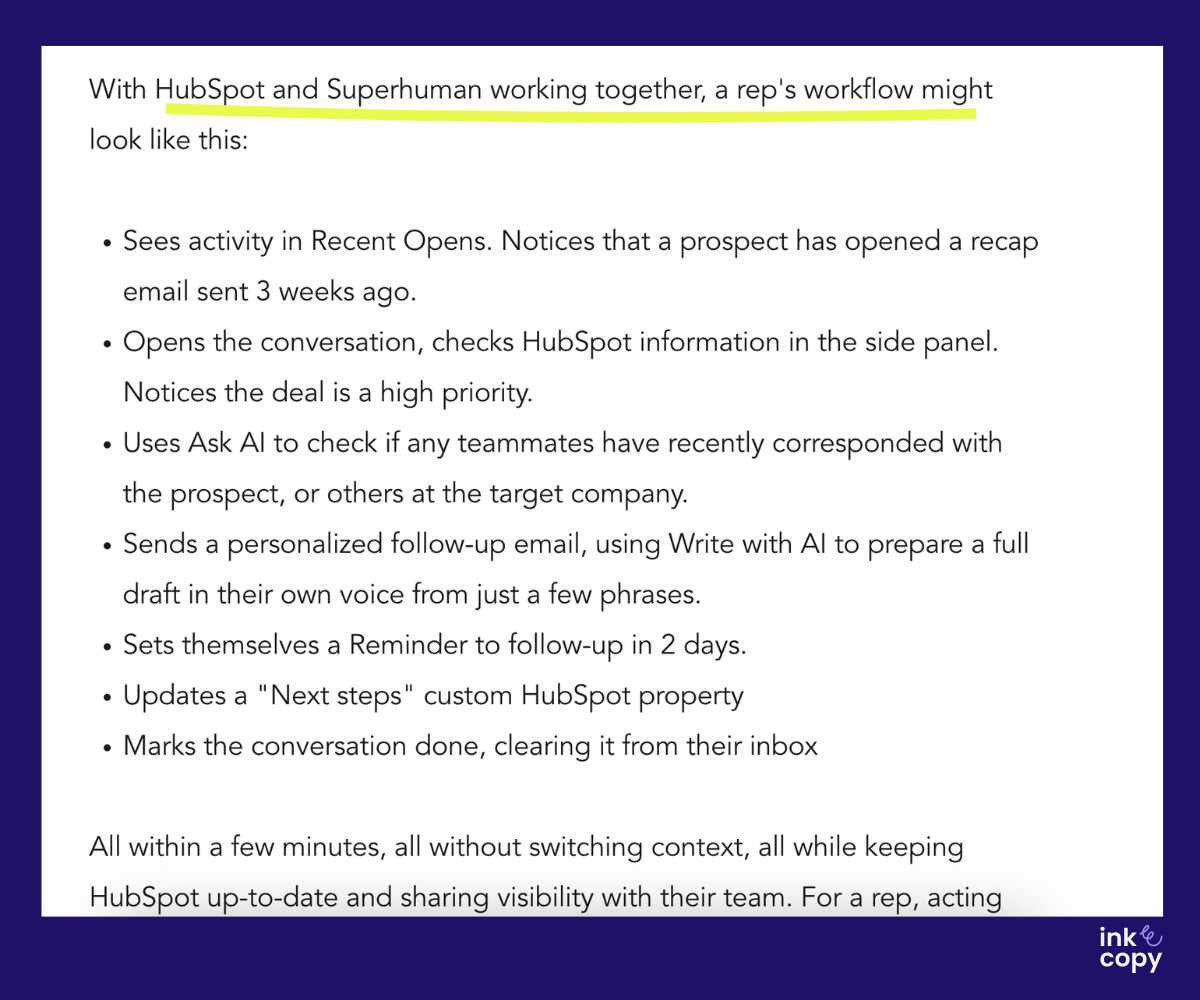
Besides lacing social proof throughout the piece, it also helps readers ‘visualize’ how smooth the workflow would look when they integrate Superhuman with HubSpot.
This is an effective way to get buyers to picture what it’d be like to use your tool, moving them closer to buying your software.
That’s all the 3 pieces under the microscope today.
Please hit reply and let me know if you found this breakdown valuable and if I should be doing more of these :)
Until then,
Ciao
P.S. Next, let me show you another type of content play for your PLC library that teams like Notion and Typeform nail.